
Ethanol-Free Gas Delivery in Southeast Florida — REC-90 Near Me, No Ethanol-Free Gas Locator Needed
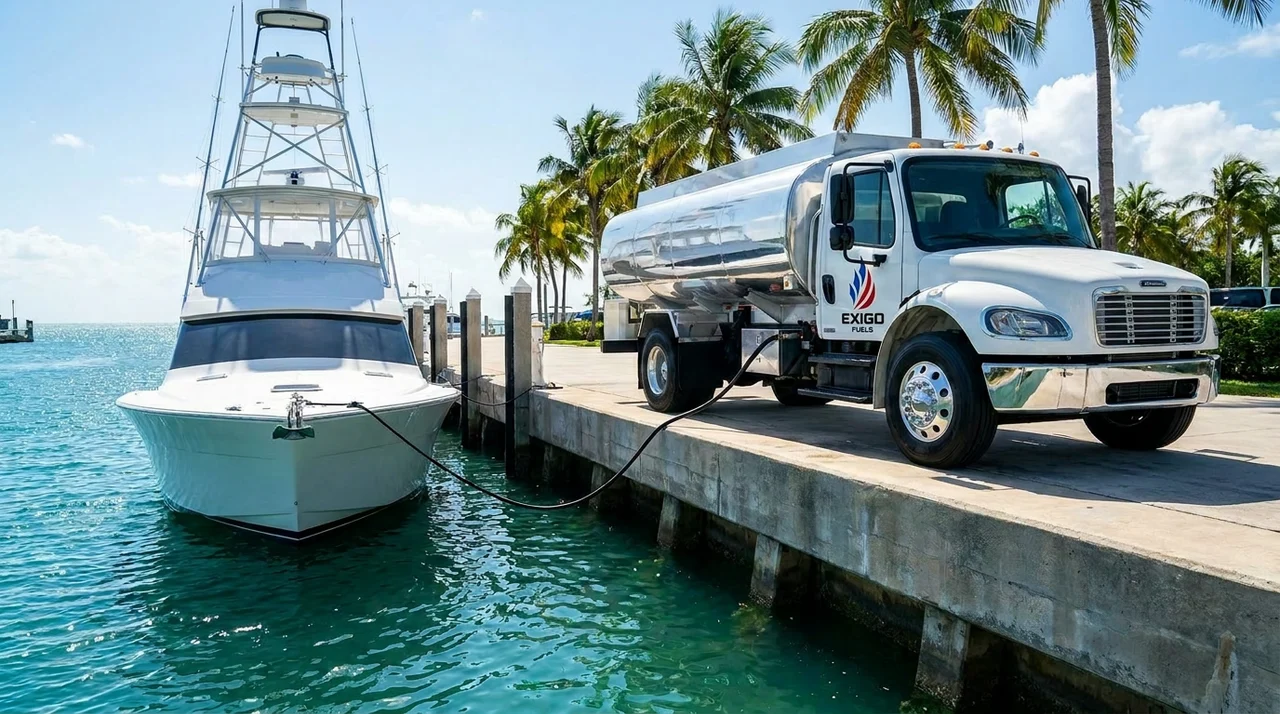
Need fuel delivered? Get a quote in minutes.
5.0 / 5 · 48 verified Google reviews · DOT-certified · 24/7 across Miami-Dade, Broward & Palm Beach
Exigo Fuels delivers REC-90 ethanol-free gasoline to marinas, boat owners, classic-vehicle storage facilities, small-engine fleets, and carbureted generator operators across Miami-Dade, Broward, and Palm Beach counties.
If you are searching for ethanol-free gas near me, recreational 90 gas near me, no ethanol fuel near me, alcohol-free gasoline, or gas without ethanol near me in Southeast Florida — for a boat at the dock, a Cobra in long-term storage, a fleet of carbureted small engines, or a stationary generator that does not tolerate E10 — we bring 90-octane no-ethanol gasoline directly to your tank, slip, or storage facility. The product is delivered as REC-90 (recreational 90 ethanol-free gasoline) meeting ASTM D4814, the same fuel sometimes called E0, 0% ethanol gas, or pure gas.
Dispatched 24/7 from our Hialeah base under US DOT# 4223712. Call (305) 900-6725 for immediate ethanol-free gas dispatch, or a written quote on a marina or fleet account.
Read the full guide
What Is REC-90 / Ethanol-Free Gas?
What is ethanol-free gas? Ethanol-free gas is gasoline produced and sold without the 10% ethanol blend that defines standard US pump gasoline (E10). The base fuel is the same refinery product — finished gasoline meeting ASTM D4814 — minus the rack-blending step that adds ethanol downstream of the refinery.
What is REC-90? REC-90 is Florida's standard ethanol-free product. The label stands for recreational grade at 90-octane (R+M)/2, no ethanol, refined to the same ASTM D4814 specification as 87 or 93 octane pump gasoline minus the ethanol blending. REC-90 is the product almost every Florida marina, boat dealer, classic-car shop, and small-engine retailer specifies when they sell or stock "non-ethanol gas".
The 90-octane figure sits between regular (87) and premium (93) and matches what most marine, small-engine, and vintage-vehicle owner manuals specify as the recommended fuel grade.
Other names for the same product — non-ethanol gas, pure gas, E0, no-ethanol gasoline, recreational gas — all describe REC-90 in practice. The Florida channel is REC-90; in some out-of-state markets the equivalent product is sold at 87 or 91 octane under the E0 label.
Who Uses Ethanol-Free Gas in Florida?
Ethanol-free gas demand in Florida is driven overwhelmingly by the marine sector, with meaningful secondary demand from vintage and classic vehicles, small engines, and legacy-design generators. The state's year-round boating culture, the high humidity that accelerates ethanol-related fuel problems, and the concentration of saltwater corrosion risks together make Florida one of the largest ethanol-free gas markets in the US.
Typical REC-90 / ethanol-free customers in Southeast Florida:
- Marinas and dockside fuel pumps: commercial and private marinas across Port Everglades, Bahia Mar, Pier 66, Sunset Harbour, Miami Beach Marina, Aventura Marina, Palm Harbor Marina, Old Port Cove, and the smaller commercial docks that stock REC-90 for transient and slipped boaters. Marina dockside REC-90 pumps consume 5,000–50,000 gallons per month at peak season.
- Boat owners and yacht operators: personal owners of outboard-powered center consoles, sport fishers, day cruisers, and yachts up to ~50 feet who fuel from private dock tanks rather than commercial marina pumps. Inboard gasoline engines (older sterndrives) are particularly vulnerable to ethanol-induced phase separation.
- Vintage and classic vehicle storage facilities: climate-controlled storage units in Miami-Dade, Broward, and Palm Beach holding pre-1990 collector cars and motorcycles. Pre-fuel-injection carbureted engines and the rubber/cork seals in 1960s and 1970s fuel systems are the textbook example of ethanol-incompatible hardware.
- Small-engine fleets: landscape contractors, golf-course maintenance crews, marine charter operators with secondary engines (tenders, dinghies), and rental fleets running carbureted 2-stroke and 4-stroke equipment. Two-stroke handheld equipment (chainsaws, blowers, trimmers) is especially vulnerable to ethanol-degraded fuel sitting between uses.
- Carbureted generators: older portable and standby generators with carbureted gasoline engines used for hurricane backup, construction sites, and outdoor events. Modern fuel-injected generators tolerate E10 fine; pre-2010 carbureted units often fail their first start after sitting on E10 for several months.
- Aviation ground support and racing: some legacy-design ground support equipment and amateur motorsports applications spec ethanol-free for fuel-system compatibility. We do not supply commercial aviation fuel (Avgas 100LL or Jet A).
Florida's specific drivers of ethanol-free demand include the Atlantic and Gulf boating seasons, year-round saltwater fishing operations, the concentration of pre-1990 collector vehicles in private storage across the tri-county area, and hurricane-season generator stockpiling June 1 to November 30.
Why Ethanol Damages Marine and Small-Engine Fuel Systems
Ethanol is the workhorse oxygenate in US gasoline, blended at 10% in standard E10 pump fuel to meet the EPA renewable fuel standard. In a daily-driven car the 10% ethanol content is essentially invisible — the vehicle burns through a tank every week or two, the fuel system stays purged, and the rubber and metal components in modern fuel-injected systems are designed for ethanol exposure.
In a boat, vintage car, or seasonal small engine the same E10 becomes a fuel-system killer for three independent reasons:
- Hygroscopic water absorption: ethanol actively pulls water vapor out of humid air through fuel-tank vents. Florida's year-round humidity (often 60–90% relative humidity) accelerates the process. A boat tank of E10 left sitting through a 6-month off-season can absorb 0.5–2.0% water by volume, depending on tank venting and humidity exposure.
- Phase separation: once the absorbed water exceeds about 0.5% by volume, the ethanol-water mixture drops out of solution and forms a separate layer at the bottom of the tank. The fuel pickup, which sits at the bottom, then feeds the engine a corrosive ethanol-water mixture instead of gasoline. Symptoms range from rough running to complete failure to start. Phase-separated fuel cannot be re-blended — the fix is to drain and dispose of the contaminated fuel.
- Material incompatibility: ethanol attacks pre-1990 fuel-system rubbers, softens fiberglass resin in early-generation fuel tanks, and accelerates aluminum corrosion in carburetor jets and floats. It also dissolves varnish and gum buildup that older fuel left behind, sending the resulting solid debris through the fuel filter and into the carburetor or injection system.
REC-90 ethanol-free gasoline eliminates all three failure modes. The fuel does not absorb water, does not phase separate, and does not attack legacy fuel-system components. For any boat, vintage vehicle, or small engine that sits between uses for more than a few weeks at a time, ethanol-free fuel converts a routine fuel-quality risk into a non-issue.
Where to Buy Ethanol-Free Gas Near You in Southeast Florida
Where to find ethanol-free gas near me in Florida is the single most common question we get from new customers — and the answer is that retail distribution is much thinner than for E10. Most pump-gas stations across Miami-Dade, Broward, and Palm Beach carry only E10. The recreational-use REC-90 channel is concentrated at:
- Marina dockside pumps (the largest distribution channel)
- A handful of dedicated boat-area inland stations
- Direct bulk delivery to private dock tanks, classic-vehicle storage, and commercial small-engine fleets
Where can I buy ethanol-free gas in quantity for a marina, fleet, or large private operation? Exigo Fuels delivers REC-90 across all three Southeast Florida counties. Common delivery destinations:
- Marina dockside refills: direct rack-to-pump delivery for marina operators stocking REC-90 at the dock. Coverage spans Aventura Marina, Sunset Harbour, Miami Beach Marina, the Port Everglades commercial and recreational basins, Bahia Mar, Pier 66, Old Port Cove, Palm Harbor, and the smaller Pompano, Hollywood, and Dania commercial marinas.
- Private dock tanks: single-owner refills of dock-mounted gravity-feed tanks at private residences along the Intracoastal, the New River, and the canals system across Fort Lauderdale, Miami, and Palm Beach Island. Typical tank sizes 100–1,500 gallons.
- Classic-vehicle storage facilities: climate-controlled storage operators with on-site fueling stations for stored collector vehicles. Concentrations in north Miami-Dade and Broward.
- Small-engine and landscape fleets: dedicated bulk tanks for landscape contractors, golf-course operations, and rental yards running carbureted equipment that requires ethanol-free fuel.
- Generator installations: carbureted-generator main tanks at facilities that spec ethanol-free for long-term standby duty cycles.
Typical Exigo Fuels REC-90 order size runs 250 to 5,000 gallons per drop, with 250 gallons as the minimum for marine-dock delivery and 500+ gallons for marina account refills. Tank requirements are standard: any code-compliant aboveground gasoline storage tank, marine dock pump, or equipment tank with a standard fill connection is serviceable. Marine dockside delivery uses the standard fueling connections built into the marina infrastructure.
Using an Ethanol-Free Gas Locator — What the Maps Show, and What They Miss
Most people arrive at this problem through an ethanol-free gas locator — search it as ethanol free gas locator and you land on the same thing: a crowd-sourced map of pumps that sell E0, filtered by state. Those maps are genuinely useful and worth checking — across the United States they are the only practical index of a fuel that no major brand advertises on its canopy. Two limits are worth knowing before you plan a Saturday around one.
- The listings go stale. Entries are user-submitted and a station that dropped its REC-90 tank last season can sit on the map for months. The pump you drove to is the one data point the locator cannot verify.
- They index pumps, not volume. A locator is built for someone filling a 5-gallon can. If you need 250 gallons for a marina tank, a fleet of carbureted small engines, or a stationary generator, a retail pump is the wrong channel regardless of how close it is — you would be running dozens of transactions through a nozzle rated for a car.
That second point is where delivery replaces the search. Exigo Fuels loads REC-90 at the terminal rack and brings it to the slip, the yard, or the storage facility, so the question stops being which pump still carries it and becomes what day do you want it. The fuel is the same ASTM D4814 ethanol-free grade the locator is pointing you at, delivered in the volumes that marine engines, outboards, sterndrives, generators and small-engine fleets actually consume. Minimum is 250 gallons across Miami-Dade, Broward and Palm Beach.
Ethanol-Free Gas in Miami — REC-90 Delivery Across Miami-Dade
Ethanol-free gas in Miami is concentrated almost entirely in the marine channel. Most retail Miami-Dade pump stations stock only E10, which leaves boat owners, classic-car collectors, and small-engine operators in Miami searching for REC-90 through marinas, a few dedicated marine fuel docks, and direct bulk delivery. Exigo Fuels covers the full county from our Hialeah base — dispatched 24/7, typical Miami delivery window 30–60 minutes under normal traffic.
Common Miami delivery destinations for REC-90 ethanol-free gas:
- Miami Beach and the Beaches: dockside REC-90 delivery for the Sunset Harbour Yacht Club basin, Miami Beach Marina at the south tip of the island, Pier 5 and the Eden Roc / Fontainebleau private docks along Indian Creek, and the residential dock tanks on Sunset Islands, Star Island, Hibiscus Island, Palm Island, and the Venetian Causeway homes facing Biscayne Bay.
- Coconut Grove and Dinner Key: Dinner Key Marina, the Coconut Grove Sailing Club, Monty's marina basin, and the private docks along Biscayne Bay between The Kampong and Matheson Hammock. The Grove is the second largest concentration of recreational marine REC-90 demand in Miami after Miami Beach.
- Key Biscayne: Crandon Park Marina on the bay side and the private dock tanks along Mashta Drive, Harbor Drive, and the West Mashta canals. Crandon is a regular REC-90 dockside refill account.
- Brickell, Edgewater, and the Miami River: condo-tower private docks along the Miami River, the new Edgewater marinas, and the Brickell Key dock infrastructure. Miami River commercial-marine operators run a mix of clear ULSD for working boats and REC-90 for the recreational and sport-fish fleet that bases in the river basins.
- Coral Gables, Pinecrest, and South Miami: private dock tanks along the Coral Gables canals and the Snapper Creek system, and bulk REC-90 tanks at the classic-vehicle storage facilities concentrated in the Bird Road and Pinecrest corridors. Pre-1990 collector cars in long-term Miami storage are a steady REC-90 customer base — climate-controlled storage operators with on-site fueling spec ethanol-free for any vehicle sitting more than a month between drives.
- Doral, Medley, and the Airport West industrial belt: bulk REC-90 tanks at landscape contractor yards, golf-course maintenance compounds (Doral, Trump National, the Biltmore), small-engine rental fleets, and carbureted standby generators at warehouses and data centers along the NW 41st Street corridor. Doral is also a regular destination for off-road diesel deliveries — see our Doral fuel delivery page for the diesel side.
- Aventura, Sunny Isles, and North Miami Beach: Aventura Marina and Turnberry Isle dock pumps, and the private dock tanks lining the Intracoastal between Bal Harbour and the Broward county line. Northern Miami-Dade REC-90 demand is dominated by the Aventura / Williams Island residential dock concentration.
- Hialeah, Hialeah Gardens, Miami Lakes, and the western county: bulk REC-90 for landscape contractors, equipment rental yards, and the carbureted-generator stockpiles that build through hurricane season. Our dispatch hub sits inside Hialeah, so western-county REC-90 deliveries typically run the shortest window of any city in Miami-Dade.
- Homestead, Cutler Bay, Palmetto Bay, and South Dade: private agricultural and rural dock tanks south of SW 152nd Street, classic-vehicle storage in the rural Redland area, and carbureted small-engine fleets at the south-county nurseries and landscape operators. South Dade deliveries are scheduled within the standard 1-2 business day window.
Miami marina dockside REC-90 refills are a standing-account product — we run scheduled deliveries to recurring marina accounts and on-call dispatch to private dock tanks and fleet operations. Typical Miami order size 250 to 5,000 gallons per drop; the 250-gallon minimum applies to single-tank private and marina deliveries. For higher volumes — marinas restocking dock pumps, classic-vehicle storage facilities, fleet operators — written contract pricing narrows the per-gallon premium considerably vs retail dock-pump cost.
For the broader Miami fuel product mix — clear ULSD, dyed off-road diesel, and ethanol-free REC-90 — see our Miami fuel delivery page. For direct vessel refueling rather than dock-pump or tank delivery, see boat fueling service and our marine fuel programs for commercial and recreational marine accounts.
Call (305) 900-6725 to schedule Miami REC-90 dispatch, or request a quote with your delivery address and tank specs.
REC-90 vs E10 Pump Gas — Practical Differences
Side-by-side comparison of standard E10 pump gas and REC-90 ethanol-free in Florida:
- Ethanol content: E10 contains 10% ethanol by volume; REC-90 contains 0%.
- Octane: Pump gas is sold at 87, 89, and 93 (R+M)/2. REC-90 is 90 octane — between regular and premium, matching most marine and small-engine spec.
- Energy content: REC-90 carries about 3% more BTU per gallon than E10 (gasoline has higher energy density than ethanol). Practical effect: 2–4% better fuel economy on the same engine, and slightly higher peak power output on engines tuned to take advantage of the extra octane.
- Water absorption: E10 actively absorbs atmospheric water through tank vents; REC-90 does not. This is the single largest functional difference for marine, vintage, and seasonal applications.
- Material compatibility: E10 is incompatible with pre-1990 fuel-system rubbers and some fiberglass tank designs; REC-90 is compatible with all gasoline-rated fuel-system materials including legacy components.
- Shelf life in storage: E10 begins phase-separating after several months in a humid environment; REC-90 stores stably for 12–24 months with proper stabilizer treatment, longer without.
- Price: REC-90 typically runs $0.50–$1.00 per gallon higher than E10 at retail in Florida, narrower in bulk delivery contracts.
- Specification: Both fuels are sold under ASTM D4814 with the same volatility, sulfur, and detergent-additive requirements; the only spec difference is ethanol content.
Mixing E10 and Ethanol-Free Gas
Can you mix ethanol and non-ethanol gas? Yes — E10 and REC-90 mix freely and the resulting blend burns fine in any gasoline engine. The blend ratio determines the ethanol percentage of the resulting fuel: a 50/50 mix yields E5, a 25/75 ethanol-free-heavy mix yields about E2.5, and so on.
The practical limit is not engine compatibility — gasoline engines are agnostic to ethanol percentages between 0 and 10. The limit is the water-absorption and phase-separation risk that the ethanol-free fuel was avoiding. Even E2 or E3 left sitting in a humid Florida environment for 4–6 months will absorb enough water to begin phase-separating. For boats, vintage vehicles, and seasonal small engines, the cleanest fuel-system management is to keep the tank exclusively on REC-90 and avoid mixing with E10.
For daily-driven vehicles that are not vulnerable to ethanol — modern cars, trucks, motorcycles built since the late 1980s — mixing partial REC-90 and E10 fills is harmless. The blend simply runs as a slightly-lower-ethanol gasoline and the engine notices nothing.
What if I accidentally put non-ethanol gas in my car? Nothing bad. Modern vehicles are designed for any ASTM D4814 gasoline up to E10. Filling a modern car with REC-90 gives a small fuel-economy bump (roughly 2–4% better mileage) and costs more per gallon. There is no engine, sensor, catalyst, fuel-system, or warranty concern — the fear is misdirected. The real ethanol compatibility issue runs in the opposite direction: putting E10 into a boat, vintage car, or carbureted small engine is what creates problems, not the reverse.
Ordering Ethanol-Free Gas Delivery from Exigo Fuels
Two ways to order REC-90 delivery. For urgent or scheduled marina dockside delivery, call (305) 900-6725 — our dispatcher confirms the delivery address, fuel volume, dock or tank access, and equipment details, and gives a live ETA from Hialeah. For standing marina accounts, scheduled storage facility refills, or a written quote on projected annual volume, submit a contact form with your ZIP code and monthly REC-90 estimate and we respond within 2 business hours. You can also request a quote online with your delivery address and tank specs.
Typical order parameters: 250–5,000 gallons per drop, 250-gallon minimum for marine dockside, 250-gallon minimum for inland-tank delivery, 500+ gallons for standing marina or fleet accounts. Standard delivery windows are 1-2 business days across Miami-Dade, Broward and Palm Beach County. We coordinate marina dock access and tide windows for waterside fueling where required.
Every delivery ships with full DOT-compliant paperwork. Our drivers carry current Hazardous Materials endorsements and every tanker is placarded per 49 CFR Part 172. We operate under US DOT# 4223712 from our Hialeah dispatch hub. Marine and small-engine operators looking for related services may also be interested in our boat fueling service for direct vessel refueling, our marine fuel programs for commercial and recreational fleet accounts, and our off-road diesel delivery for the diesel-side equivalent product.
Ethanol-Free Gas Frequently Asked Questions
What is ethanol-free gas?
Ethanol-free gas is gasoline that contains no ethanol — pure refinery-grade gasoline meeting ASTM D4814. Standard US pump gasoline is E10 (10% ethanol blended at the rack); ethanol-free product skips that step. In Florida the most common ethanol-free product is REC-90, a 90-octane recreational-use gasoline produced specifically for marine, small-engine, and classic-vehicle applications where ethanol creates fuel-system problems.
What is REC-90?
REC-90 is Florida's standard ethanol-free recreational gasoline. The label means recreational grade at 90-octane (R+M)/2, no ethanol, refined to the same ASTM D4814 specification as pump gasoline minus the ethanol blending. REC-90 is what most Florida marinas, boat dealers, and classic-car shops mean when they sell or stock "non-ethanol gas".
Why do boats need ethanol-free gas?
Boats need ethanol-free gas because ethanol absorbs atmospheric water through fuel-tank vents (hygroscopic), drops out of solution as a separate corrosive layer once water content exceeds 0.5% (phase separation), and attacks legacy fuel-system rubbers and fiberglass tank resin. Florida's year-round humidity accelerates all three failure modes. REC-90 eliminates them.
Where can I buy ethanol-free gas near me in Florida?
Most retail Florida gas stations carry only E10. Ethanol-free is distributed primarily through marinas, dockside fuel pumps, a small number of dedicated boat-area inland stations, and bulk commercial delivery to private tanks. Exigo Fuels delivers REC-90 across Miami-Dade, Broward, and Palm Beach to marinas, private dock tanks, classic-vehicle storage facilities, small-engine fleets, and carbureted-generator operators. Call (305) 900-6725 for dispatch.
Is there an ethanol-free gas locator for South Florida?
Yes — crowd-sourced pure-gas maps index the retail pumps that still carry E0 across the United States, and they are worth checking if you need a few gallons for a can or a tank on a trailer. They have two known weaknesses: listings are user-submitted and go stale when a station drops the product, and they only index retail pumps, which is the wrong channel above about 50 gallons. For marina tanks, small-engine fleets, classic-vehicle storage and standby generators, bulk delivery replaces the locator entirely — Exigo Fuels brings REC-90 to the slip or the yard across Miami-Dade, Broward and Palm Beach with a 250-gallon minimum. Call (305) 900-6725.
Can I mix ethanol and non-ethanol gas?
Yes — E10 and REC-90 mix freely with no engine damage. The blend ratio simply yields a lower-ethanol fuel. The catch is that any non-zero ethanol percentage reintroduces water-absorption and phase-separation risk, partly defeating the purpose for boats and seasonal engines. For modern daily-driven vehicles, mixing is harmless.
What happens if I accidentally put non-ethanol gas in my car?
Nothing bad. Modern fuel-injected vehicles run on REC-90 exactly as well as on E10 — slightly better, in fact, with a 2–4% fuel-economy bump from the higher energy density. There is no engine, sensor, catalyst, fuel-system, or warranty issue. The real ethanol-compatibility problem runs the opposite direction (E10 into boats and vintage engines), not pure gas into a modern car.
Is REC-90 the same as ethanol-free gas?
Yes. REC-90, ethanol-free gas, non-ethanol gas, pure gas, E0, and recreational gasoline all describe the same product in Florida: 90-octane gasoline meeting ASTM D4814 with no ethanol blending. REC-90 is the specific 90-octane recreational grade name; the other terms are colloquial labels for the same fuel.
How much does ethanol-free gas cost?
Ethanol-free gas typically runs $0.50–$1.00 per gallon higher than E10 pump gasoline at retail in Florida. The premium reflects skipped ethanol blending (and lost RIN credits to the producer), lower distribution volume than E10, and recreational-channel markups. Bulk delivery contracts narrow the per-gallon spread vs retail dock-pump pricing, particularly for marinas and high-volume operators.
How long can ethanol-free gas be stored?
REC-90 stores stably for 12–24 months under typical Florida conditions with a fuel stabilizer added (Sta-Bil, Star Tron, PRI-G, or equivalent), and 6–12 months without stabilizer. Compare to E10, which begins phase-separating after a few months in humid storage. For boats laid up over the off-season, vintage cars in long-term storage, and hurricane-season generator stockpiles, the longer storage life is one of the main practical reasons to spec REC-90 over E10.
Where can I get ethanol-free gas in Miami?
Most retail Miami gas stations carry only E10. Ethanol-free is distributed through marinas (Miami Beach Marina, Sunset Harbour, Dinner Key, Crandon Park, Haulover, Pelican Harbor), dedicated marine fuel docks, and direct bulk delivery to private dock tanks and bulk storage. Exigo Fuels delivers REC-90 anywhere in Miami-Dade — Miami Beach, Coconut Grove, Key Biscayne, Coral Gables, Doral, Aventura, Brickell, Sunny Isles, Hialeah, Homestead — dispatched from Hialeah, standard 1-2 business day delivery window. Call (305) 900-6725 to schedule REC-90 in Miami.
Related Services
Exigo Fuels delivers the full Southeast Florida fuel mix — clear on-road ULSD, red dyed off-road diesel, ethanol-free REC-90, and E10 gasoline — across Miami-Dade, Broward, and Palm Beach counties. For other product lines and customer types, see:
- Boat Fueling Service — direct vessel refueling at marinas, private docks, and commercial fishing slips
- Marine Fuel Programs — commercial and recreational marine accounts, dock-pump refill schedules
- Off-Road Diesel Delivery — red dyed diesel for construction, agriculture, generators, and commercial marine
- On-Site Fuel Delivery — full mobile fuel program for fleets, jobsites, and private operations
- Generator Refueling — main-tank and day-tank refills for stationary backup power
- Diesel Fuel Supplier — ULSD and dyed diesel supply contracts