
Hurricane Fuel Preparedness Checklist for Florida Commercial Operators
Every hurricane season, Florida operators discover the 60-hour fuel gap the hard way. Retail pumps run dry inside 4 hours once a named storm enters the NHC cone and mandatory evacuation is declared. Grid power then fails, and even stations with fuel in the tank cannot dispense it. Contracted bulk customers who scheduled a pre-storm top-off at 72 hours out keep operating through landfall and the first 96 hours of recovery. Customers who did not, do not. This checklist is built on the actual patterns Exigo Fuels sees every hurricane season across Miami-Dade, Broward, and Palm Beach counties — no generic FEMA boilerplate, specific numbers, real NFPA codes, and honest constraints about what you can and cannot expect once the NHC cone is issued.
Download the PDF version
Save this checklist to your emergency operations binder, share it with your facilities team, or print copies for each site.
Download Checklist (PDF)You can also press Ctrl+P (or Cmd+P) to save this page directly as PDF — print styles are built in.
Phase 1 — Pre-Season (June 1 onward): The Foundation Month
The Atlantic hurricane season officially runs June 1 to November 30. Everything you fail to do in June becomes expensive in September when a Cat 3 is in the cone and every generator contractor, fuel supplier, and electrical crew in South Florida is already booked. Pre-season is when the relationships, inspections, and documentation get locked in — not when the cone lights up.
- Bulk tank inspection and annual maintenance. Above-ground and underground tanks both need a visual inspection for corrosion, weld seam integrity, vent condition, and fill cap seating. Pull a lab sample for water content (ASTM D6304 Karl Fischer), particulate (ASTM D6217), and microbial growth (ASTM D6469). Any tank sitting more than 12 months without turnover should get this testing.
- Fuel polishing service. If your lab sample exceeds ASTM D975 limits — water above 200 ppm, particulate above 18 mg/L, or any microbial colony count — schedule fuel polishing in May or early June. Polishing a main tank takes 4-8 hours and cannot happen during hurricane week because capacity is gone.
- Generator load test documentation. NFPA 110 Level 1 requires a monthly no-load exercise and an annual load-bank test to 30% minimum. File the test records with your facilities binder — insurance and AHJ inspectors ask for them after any generator-related incident.
- Fuel supplier contract — relationship established, not ad-hoc. Verify your supplier offers a documented emergency-response tier structure (1-hour critical, 2-hour urgent, 4-hour standard). If you depend on retail pumps or a spot-market broker, you will not have priority dispatch when the cone is issued. Contracted status is the only meaningful differentiator during a landfall event.
- Emergency-response tier selection. Decide which tier your site needs — 1-hour is for hospitals, life-safety, and data center main tanks; 2-hour is for business-critical commercial; 4-hour is for planned commercial refills. Pick based on your actual load-shed consequence, not optimism.
- Contact list update. Fuel dispatcher direct line, generator service company, electrical contractor, AHJ contact, and internal facilities chain of command. Phone numbers, not generic email. Test every number in June — turnover between seasons is normal.
- DEF supply plan (Tier 4 generators only). Exigo does not deliver DEF — confirm an alternative source (commonly a local industrial supply house or your generator service provider) with committed delivery capacity through hurricane season. Running out of DEF on a Tier 4 engine will force a derate or shutdown.
- Site access credentials for your fuel supplier. Gate codes, after-hours contacts, any post-storm law enforcement access documents. Post-hurricane roadblocks are real and a driver without paperwork does not get through.
Phase 2 — 72 Hours Before Landfall: The Decision Point
Once the NHC issues a tropical storm or hurricane watch and your county falls inside the 5-day cone of uncertainty, you are on the clock. The 72-hour mark is the last window where capacity is still reasonably available — every supplier will be on a first-come route plan, and the fleet that was designed to service 40 customers a day is about to be asked to service 200.
- Monitor NHC cone-of-uncertainty updates every 6 hours. The 5am, 11am, 5pm, 11pm advisories refine the track. If your county is inside the cone and the center line is within 150 miles of your site, initiate your plan. Do not wait for the 48-hour advisory.
- Top off main tanks to 100%, not 90%, not 95%. NFPA 110 Level 1 language reads "maintain at or above 100%" for hurricane preparedness posture. The 90% number applies to routine operations. Full tanks also reduce condensation — a full tank has no air space to breathe moisture overnight.
- Schedule pre-storm top-off with your contracted supplier. Call dispatch directly, confirm your tier, and lock in a delivery window inside 48-24 hours before projected landfall. This is the load that keeps you running. Miss this call and you are running on what is already in the tank.
- Verify on-site storage capacity for full runtime plus 50% buffer. Example: a 500 kW diesel genset running at 75% load burns roughly 36 gal/hr. For 96 hours of projected runtime, that is 3,456 gallons. Add 50% buffer (1,728 gallons) = 5,184 gallons minimum on site before landfall. Size against your actual load curve, not the generator nameplate.
- Generator test under load — not just no-load. Run a load test at minimum 50% of rated output for 30+ minutes. No-load exercises let a generator wet-stack and mask injector or turbo faults that only surface under real load. You do not want to discover injector failure on day 3 of an outage.
- Confirm driver access credentials for post-storm delivery. Gate codes active, security contact reachable, Florida DEM access documentation on file if you are in an evacuation zone. Drivers running post-storm routes will not wait for you to find a gate opener.
- DEF reservoir check (Tier 4 generators). Top the DEF reservoir now. Confirm alternative supply — Exigo does not deliver DEF. If your generator derates or shuts down on a DEF-dosing fault mid-storm, you have no supply channel to recover it.
- Communicate internally. Facilities director, on-call engineer, and leadership know the fuel posture, the refill trigger level, and the emergency dispatch contact. Do not assume the information traveled.
Phase 3 — 24 Hours Before Landfall: Lock It Down
The last 24 hours are for closing gaps, not for top-offs. If you still need fuel at T-24h, dispatch capacity is mostly gone and retail queues are 90 minutes deep. Your focus shifts to mechanical readiness and post-storm access planning.
- Final fuel top-off — if dispatch capacity still available. Call dispatch to confirm. Some suppliers suspend delivery inside 24 hours of projected landfall for driver safety. Know your supplier's cutoff before you assume a truck is rolling.
- Generator transfer switch test. Exercise the ATS in both directions under actual generator power. A sticky transfer switch is the failure mode that catches facilities on day 1 of the outage — the generator runs fine and the building still has no power because the switch did not transfer.
- Tank inspection for leaks, vents, caps. Walk every tank. Vent caps torqued, fill caps seated with gaskets intact, sight gauges unbroken, spill buckets drained. Wind can lift unlatched caps; storm surge can push water into a poorly-sealed fill port.
- Retail pump queue avoidance — final warning. If you have pickup trucks, service vans, or small equipment you planned to fill at retail, stop now. T-24h retail pumps in Miami-Dade are already backed up; T-12h they are empty or shut down on grid stress. Hold fleet vehicles in your yard with what is in the tank.
- Emergency dispatch contact verification. Confirm the phone number, confirm a backup method (SMS, account email). Cell networks saturate during landfall — know both a primary and fallback channel.
- Site access plan for post-storm entry. Document which gate opens, which approach road floods first, which contact has keys, which route avoids low-lying sections. Drivers cannot guess your site.
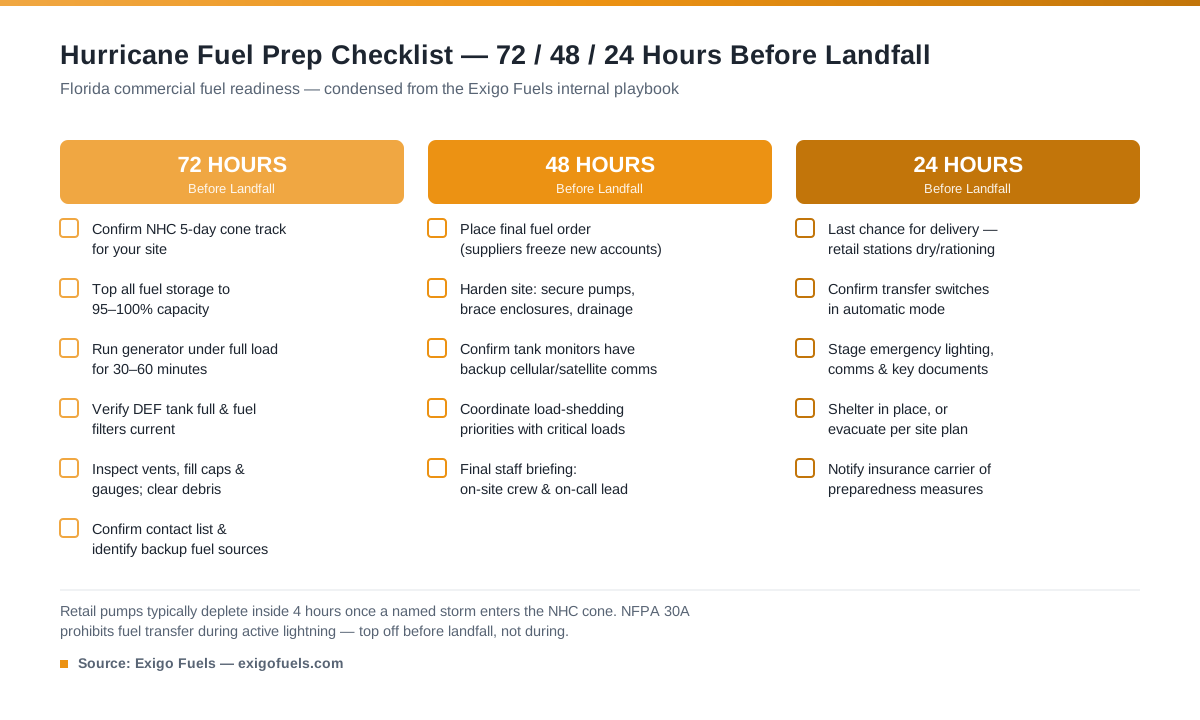
Use this chart on your site
Free to use with attribution.
<a href="https://www.exigofuels.com/resources/hurricane-prep-fuel-checklist/"><img src="https://www.exigofuels.com/charts/hurricane-fuel-checklist.svg" alt="Hurricane fuel prep checklist by Exigo Fuels"></a>
<p>Chart by <a href="https://www.exigofuels.com/">Exigo Fuels</a></p>
Phase 4 — During the Storm: Stand Down Safely
The operational window closes when sustained winds exceed 45 mph, lightning is within 10 miles, or your AHJ declares a shelter-in-place. Nothing that looks like fuel transfer happens during this phase. Your job is to run the generator, track consumption, and not create a secondary emergency.
- No lightning-phase refueling. NFPA 30A §6.3.4 prohibits transfer operations during electrical storm activity. This is not a suggestion. A fuel-transfer operation during a lightning strike is a fatal-incident pattern and will also end your insurance relationship.
- Generator runtime tracking and consumption logging. Log hours on the clock every 4 hours. Calculate actual gallons per hour from your tank level drop. Projected runtime remaining = (current gallons) ÷ (actual gal/hr). Write it in a physical log — your BMS may be offline.
- If power outage starts, forecast runtime remaining. Compare to the projected grid restoration timeline from FPL or your local utility. If forecast runtime is less than projected outage, begin planning the emergency refill call for the earliest safe operating window after the storm passes.
- When to call for emergency dispatch. 60% tank level for a projected 72+ hour outage. 40% for a 24-48 hour outage. Earlier if your site is in a flood zone with post-storm access risk. Never wait until below 20% — at that point you are gambling on truck availability.
Phase 5 — Post-Landfall (0-24h): First Response
The first 24 hours after eye passage or storm exit are the most logistically tight. Driver safety clearance, downed power lines, flooded access routes, and debris constrain every route. Suppliers are running priority queues — contracted customers first, by tier, by site accessibility.
- Site access assessment. Before calling for a refill, confirm your site is reachable. Debris on entry roads, flooding, roof damage that blocks the yard, downed power lines within the fuel transfer zone. Send a photo to dispatch if conditions are questionable.
- Generator fuel consumption actuals vs projected. Reconcile your log against the tank level. If actual consumption is running higher than projected (typical when cooling load spikes post-storm in humid conditions), update your refill trigger upward.
- Tank inspection — contamination from debris or water intrusion. Visual inspection of vent caps, fill caps, spill buckets. Storm surge can push water into a compromised fill port. If you suspect water, pull a sample before running the generator further — hydraulic lock or injector damage is the downside of running contaminated fuel.
- Emergency refill trigger. 60% for 72h+ outage, 40% for 24-48h. Call dispatch with tank level, site access status, and generator runtime in the first sentence — dispatch can route faster with clean data.
- Priority queue for contracted clients. First 72 hours post-landfall, Exigo runs contracted-customer routes in tier order. 1-hour critical healthcare and life-safety first, then 2-hour urgent business-critical, then 4-hour standard. New customer requests in this window cannot be accommodated.
- Fuel quality check before extended runtime. If your tank saw water intrusion, any visible debris, or an unusual consumption curve, pull a sample before day 2 of continuous runtime. Fuel polishing is the remediation if ASTM D975 limits are exceeded — better to polish between refills than to lose a generator on day 3.
Phase 6 — Extended Outage (24-96h): Sustained Operations
Past the 24-hour mark, the immediate dispatch crush eases and scheduled refill cadence takes over. This is where fuel-quality risk and crew fatigue become the dominant failure modes, not supply.
- Scheduled refill cadence based on actual runtime. At actual gal/hr × projected outage hours remaining, you know your refill intervals. Most 96-hour outages end up on 48-hour refill cycles for a 500 kW genset with 2,000-3,000 gallon main tanks. Set a standing order with dispatch.
- Grid restoration signal monitoring. FPL outage map, local utility dashboard, and AHJ bulletins. When restoration projection moves inside 12 hours, communicate with dispatch — your final refill volume may be smaller than the scheduled cycle.
- Contamination risk mounting. Open tanks breathe humidity all day. Every refill event introduces potential debris from compromised fill ports. Any tank that was open to the atmosphere during storm surge should be sampled before extended runtime continues. Fuel polishing may be needed mid-event, not just post-event.
- Crew fatigue management. Not fuel-related, but this is when facilities teams fail. Rotate on-call staff. The person who has been awake 36 hours will misread a tank level. Build a shift rotation into the plan before the storm, not during it.
Phase 7 — Recovery (Grid Restored): Before Standing Down
Grid restoration is not the end of the fuel event. A generator that ran 72+ hours continuously has been burning fuel out of a tank that may have accumulated sediment, water, or debris during the event. The post-event checklist is what protects the asset for next season.
- Final fuel top-off before returning to scheduled delivery. Bring the main tank back to 100% on your next scheduled delivery window. Storing a tank at 40-60% through normal operations invites condensation — back to NFPA posture as soon as the event closes.
- Fuel polishing service — recommended after extended runtime. Any tank that saw 72+ hours of continuous draw, water intrusion, or an unusual consumption curve should be scheduled for fuel polishing. Sediment stirs up during high-draw operations and settles back in the bottom of the tank — the next cold start may pick it up and ruin injectors.
- Generator post-event service. Oil sample, coolant check, air filter inspection, fuel filter replacement. Schedule with your generator service provider in the first 30 days — they are slammed too, so book early.
- Documentation. Runtime hours, fuel consumed, refill dates and volumes, any issues encountered (contamination, transfer switch, load shed, DEF supply). This goes in the facilities binder and forms the basis of next year's capacity plan.
- Debrief with facilities team. What worked, what did not, where did the plan break down. A 30-minute debrief in November is cheaper than rediscovering the same gap next September.
Commercial Fuel Emergency — When to Call Exigo Fuels
Exigo Fuels operates 24/7/365 emergency dispatch from our Hialeah base for Southeast Florida commercial accounts under US DOT# 4223712. Hurricane-season fuel response is a core service segment — but the capacity model has hard limits, and we are direct about them.
- Active contracted clients: 24/7 priority dispatch. 1-hour critical tier (hospital generators, life-safety, data center main tanks), 2-hour urgent tier (business-critical operations), 4-hour standard tier (planned commercial refills). These tiers hold through hurricane conditions, with routing adjusted for post-storm site accessibility.
- New customers: we cannot promise emergency dispatch if not pre-onboarded. This is a hard rule, not a preference. Once the NHC cone is issued, our capacity commitment to contracted customers fills our route plan. A new-customer call at T-24h cannot be serviced if it displaces a tier-1 contracted client.
- The reason: we protect contracted clients' capacity first. An operator who signed a contract in May and paid for tier-1 critical dispatch has earned the 1-hour response window. We will not break that commitment to service a new customer who did not prepare.
- Pre-onboarding is 15 minutes. Call (305) 900-6725 now — in May, not during the storm. We collect site details, fuel specifications, tank configuration, access credentials, and emergency contact chain. You are then on the route plan for next event.
Call (305) 900-6725 or submit a contact form to onboard. Related services: Emergency Fueling, Generator Refueling.
Save this checklist
Download the PDF version for your emergency operations binder, or share the link with your facilities team.
Download Checklist (PDF)Related Services & Resources
- Emergency 24/7 Fuel Delivery — 1h/2h/4h response tiers
- Generator Refueling — NFPA 110 Level 1 compliant
- Fleet Fueling Programs — pre-season contract setup
- Fuel Polishing — pre-season and post-event tank remediation
- On-Site Fuel Delivery — bulk and direct-to-equipment
- Fuel Delivery Blog — operational analysis and cost guides
- All Southeast Florida Service Areas
Frequently Asked Questions
How much fuel should we have on site before a hurricane?
Plan for full generator runtime of 96 hours plus a 50% buffer — that is the practical Florida standard for healthcare, data center, and life-safety facilities. NFPA 110 Level 1 requires the stored main tank at 100% before the storm, not 90%. For a 500 kW generator running at 75% load, that is roughly 36 gal/hr × 96 hr × 1.5 buffer = ~5,200 gallons on site. Size your storage against your own generator curve and load, not a generic rule of thumb.
Can we get fuel delivery during the storm?
No. NFPA 30A prohibits fuel transfer during active lightning and high-wind conditions, and we will not put drivers on the road during a named-storm landfall. Our operating window closes when sustained winds exceed 45 mph or lightning is within 10 miles of dispatch. This is why the pre-storm top-off 72-24 hours out is the decisive event — after that, you run on what is in your tank until conditions clear.
What happens to retail pump availability during hurricane landfall?
Retail stations run dry on a predictable curve. Florida DEM data from recent landfall events shows retail diesel depletion inside 4 hours once a named storm enters the NHC cone and mandatory evacuation is declared. Pump electronics then fail with grid power loss — even stations with fuel cannot dispense. Operators who depend on retail pumps for fleet or generator fuel during hurricane season experience 60-hour fuel gaps routinely. Contracted bulk delivery customers with pre-storm top-off do not.
Does Exigo deliver to new customers during a hurricane?
No. Active contracted customers get priority dispatch — 1-hour, 2-hour, and 4-hour emergency tiers — during and after hurricane events. New customers who call after the NHC cone is issued cannot be promised emergency dispatch because we must protect the capacity committed to customers already on our roster. Pre-onboarding takes 15 minutes and should be done in May, not during a storm. Call (305) 900-6725 now if you have not been onboarded.
When should we call for emergency refuel after a hurricane?
For a projected 72+ hour outage, call when tank level hits 60%. For a 24-48 hour outage, 40% is the threshold. Earlier if your site is in a flood zone with restricted post-storm access — we may need to run routes based on which addresses are reachable, and contracted customers in accessible zones get served first. Never wait until you are below 20% — at that point you are gambling that our truck rolls before your load sheds.
What fuel storage tanks need inspection before hurricane season?
Every above-ground tank, UST, day tank, belly tank, and generator base tank on site. Check vent caps (wind can tear loose), fill caps (storm-surge water intrusion), sight gauges, float switches, and any sensors wired to a BMS. Test transfer pumps under load. Document water content and microbial growth via a lab sample on any tank that has been sitting more than 12 months. Fuel polishing is the remediation if ASTM D975 limits are exceeded — schedule it in May, not during landfall week.
Do standby generators need a different fuel spec for hurricane-season runtime?
No — clear ULSD diesel (ASTM D975, <15 ppm sulfur) is the standard for EPA Tier 4 Final generators regardless of season. The operational difference is fuel age and polishing cadence. Fuel that has sat in a main tank for 12+ months may exceed water and particulate limits. After a 72+ hour continuous runtime, sediment gets stirred up and should be polished before returning the tank to standby service. This is a routine post-event task, not a specification change.
Ready to Lock In Your Hurricane-Season Fuel Plan?
Call (305) 900-6725 for 24/7 dispatch, or submit a contact form to onboard for next hurricane season. Exigo Fuels serves Miami-Dade, Broward, and Palm Beach counties from our Hialeah base — 5.0 / 48 Google reviews, DOT-certified fleet, ASTM D975 batch documentation on every delivery.