
Ultra-Low Sulfur Diesel (ULSD) Delivery in Southeast Florida — ASTM D975 S15
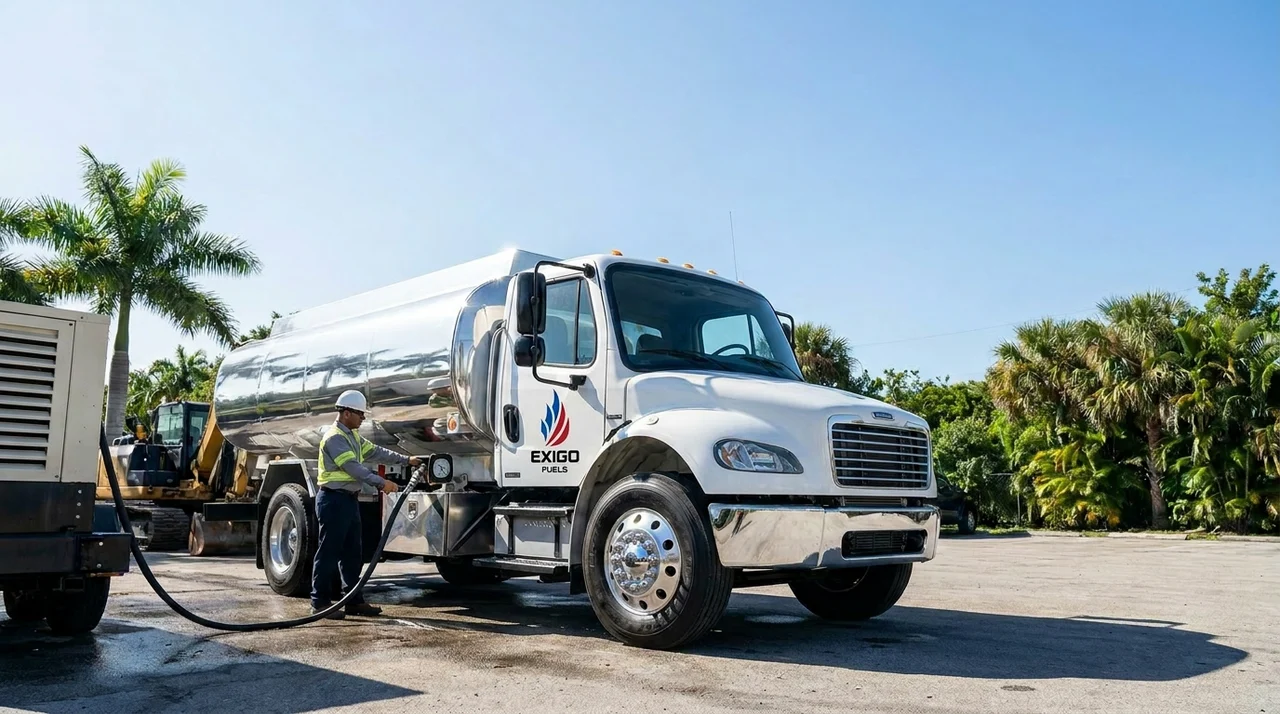
Need fuel delivered? Get a quote in minutes.
5.0 / 5 · 48 verified Google reviews · DOT-certified · 24/7 across Miami-Dade, Broward & Palm Beach
Exigo Fuels delivers ASTM D975 ultra-low sulfur diesel (ULSD) to commercial fleets, jobsite tanks, standby generators, agricultural operations, and EPA-compliant marine vessels across Miami-Dade, Broward, and Palm Beach counties.
If you operate a post-2007 on-road diesel fleet, Tier 4 Final non-road equipment, an NFPA 110 backup generator program, or any modern diesel engine with DPF, SCR, or EGR aftertreatment, the fuel you need is ULSD — and Exigo Fuels delivers exactly that, sourced from licensed terminal rack at Port Everglades and Port Miami, dispatched 24/7 from our Hialeah base under US DOT# 4223712. Call (305) 900-6725 for immediate delivery or a written quote on a standing commercial account.
Read the full guide
What Is ULSD (Ultra-Low Sulfur Diesel)?
What is ULSD? Ultra-Low Sulfur Diesel is a grade of diesel fuel containing no more than 15 parts per million (ppm) of sulfur — a 97% reduction from the 500 ppm Low Sulfur Diesel (LSD) it replaced, and a 99.7% reduction from the legacy 5,000 ppm high-sulfur diesel that was sold before the EPA emissions transition. The ULSD specification is defined under ASTM D975 grade S15 and is the only on-road diesel sold in the United States since October 2010.
The reason for the transition was emissions control. Modern diesel aftertreatment systems — diesel particulate filters (DPF), selective catalytic reduction (SCR) urea-injection systems, and exhaust gas recirculation (EGR) — are catalyst-based technologies that are poisoned and rendered ineffective by sulfur in the fuel.
The 15 ppm ceiling is the threshold below which DPF, SCR, and EGR aftertreatment can operate at full duty-cycle without catalyst poisoning. Above 15 ppm, particulate filters clog with sulfate ash, SCR catalysts lose NOx-reduction efficiency, and the combined emissions output rises rapidly. The EPA mandate transitioning the US diesel supply to ULSD started in 2006 and was completed across on-road, non-road, locomotive, and marine fuel by 2014.
Practically, every gallon of diesel sold in Florida today — at retail pumps, in commercial bulk delivery, in dyed off-road delivery under IRS §4082, and in marina dockside fueling — is ULSD. The terminal rack at Port Everglades and Port Miami no longer carries higher-sulfur grades for any practical-volume customer. The product specification is defined; the question is who delivers it, when, and at what level of compliance documentation.
Who Needs ULSD in Florida?
ULSD is the diesel fuel for any modern diesel engine. In practical Florida operations, the heaviest ULSD consumers are:
- Commercial on-road fleets: Class 8 trucking fleets, regional and last-mile delivery operations, freight haulers, refrigerated trailers, and ground transportation. Every truck built since model year 2007 has a DPF aftertreatment system that requires ULSD. Older trucks (pre-2007) also run ULSD because there is no longer a distribution channel for higher-sulfur diesel.
- Tier 4 Final non-road equipment: excavators, wheel loaders, dozers, graders, articulated dump trucks, asphalt pavers, compactors, and light towers manufactured to Tier 4 Final emissions standards (phased in 2011–2015 by horsepower category). All Tier 4 Final equipment requires ULSD; using higher-sulfur fuel voids the manufacturer warranty and damages the aftertreatment system.
- Stationary backup generators: emergency standby generator installations at hospitals, data centers, water treatment plants, telecom central offices, cold storage warehouses, and critical infrastructure. NFPA 110 Level 1 generators specified for life-safety duty cycles run on ULSD with ASTM D975 compliance documentation. Larger industrial generators (250 kW and up) may have specific cetane and lubricity requirements within the ULSD specification.
- Agricultural and irrigation diesel: tractors, harvesters, irrigation pumps, and farm equipment in the Palm Beach County sugar belt and south Miami-Dade row-crop areas. Most agricultural equipment built since 2014 is Tier 4 Final and requires ULSD; agricultural diesel typically uses red dyed off-road ULSD under IRS §4082 for the tax exemption.
- EPA-compliant marine commercial vessels: commercial fishing boats, workboats, tugboats, and dredges operating under EPA marine emissions standards. Coastal commercial vessels require ULSD; ocean-going vessels operate under separate IMO sulfur regulations that are also at or below ULSD's 15 ppm ceiling for fuel sold in US ports.
- Reefer refrigeration units: Thermo King, Carrier, and Daikin refrigeration units on refrigerated trailers and intermodal containers, delivered through a separate-tank fueling protocol from the tractor's on-road tank.
In short: any diesel engine built in the last decade and sold in the United States runs on ULSD — and any older engine still running today also runs on ULSD because that is what is available at the terminal rack. The compliance question is documentation, not product selection.
ULSD Specifications & Compliance (ASTM D975 S15)
ASTM D975 S15 is the specification every gallon of US ULSD must meet. The key parameters that affect engine performance, aftertreatment compatibility, and storage stability:
- Sulfur content: 15 ppm maximum (typical refinery production: 5–10 ppm with safety margin).
- Cetane number: 40 minimum for No. 2-D ULSD. Higher cetane (45–55) indicates better cold-start and combustion characteristics; some commercial fleets specify a premium cetane floor on bulk contracts.
- Lubricity (HFRR): 520 micrometers maximum wear-scar diameter on the high-frequency reciprocating rig test. Modern ULSD meets this with added lubricity additives — the desulfurization process removes natural lubricity that the additive package restores.
- Flash point: 52°C minimum for No. 2-D — the temperature at which ULSD vapor will ignite in a closed cup. Florida storage and handling rules reference flash point for bulk-tank classification.
- Distillation T90: 282–338°C — the temperature at which 90% of the fuel volume distills. Affects cold-flow and combustion characteristics; commercial fleets running in cooler climates may spec a T90 floor for cold-weather operation.
- Cloud point and cold-filter plugging point: climate-dependent, typically not a Florida concern except for occasional cold-snap events. ULSD with paraffin-additive cold-flow improvers can be specified for sub-32°F operation if needed.
- Water and sediment: 0.05% maximum by volume. Bulk handling and tank maintenance practices are designed to keep the fuel below this ceiling — water in fuel is the leading cause of microbial contamination in commercial diesel storage.
- Ash: 0.01% maximum — a measure of inorganic residue that can damage injectors and aftertreatment.
Every Exigo Fuels ULSD delivery includes a printed bill of lading identifying the load as ASTM D975 S15 with the source terminal and batch reference. For commercial accounts requiring batch test certificates (NFPA 110 hospital generators, pharmaceutical cold-chain operators, regulated industrial sites), full lab certificates of analysis are available on request before delivery.
ULSD vs Other Diesel Grades — Practical Differences
In current US diesel distribution, the relevant fuel grades and how ULSD relates to each:
- ULSD (clear on-road): ASTM D975 S15, 15 ppm sulfur, no dye marker, full federal and state on-road fuel tax. The standard fuel for highway-driven commercial trucks, fleet vehicles, and any modern diesel engine in mixed on-road / off-road service.
- Off-road dyed ULSD: Same ASTM D975 S15 specification, plus a red dye (Solvent Red 164) added at the terminal rack under IRS §4082 to mark the fuel as tax-exempt for non-highway use. Saves $0.40–$0.60 per gallon vs clear ULSD on qualifying off-road equipment, marine commercial vessels, agricultural pumps and tractors, and stationary generator installations. See our off-road diesel delivery page for tax treatment detail.
- Marine diesel: Generally ULSD when sold for US-port commercial vessel use. Some legacy marine spec residual fuels exist for ocean-going vessels but are not part of the Florida tri-county commercial supply.
- B5 ULSD: ULSD blended with up to 5% biodiesel (ASTM D975 still applies up to B5). Functionally identical to pure ULSD for engine compatibility and aftertreatment requirements; the biodiesel component provides slight additional lubricity and a small renewable-fuel content.
- B10–B20 biodiesel blends: ASTM D7467 specification, not D975. Approved by some commercial fleets for specific equipment; check OEM warranty before adopting.
- Heating oil (No. 2 fuel oil): Historically a separate grade with higher allowable sulfur, but in current Florida distribution most "heating oil" is simply off-road dyed ULSD because heating-only demand is too small to justify separate distribution. Demand in Florida is minimal year-round.
- Race / specialty diesel: Niche specialty fuels for motorsports applications, not typical commercial supply.
Where to Buy ULSD Near Me in Southeast Florida
Retail ULSD is available at virtually every diesel pump in Florida — but for any commercial operation consuming more than a few hundred gallons per week, retail pumps are a poor fit: operational time at the pump, no batch documentation for compliance audits, and per-gallon pricing that includes retail margin. Commercial ULSD distribution is built around three delivery models:
- Bulk tanker delivery to fixed yard tanks: 500–8,500 gallons per drop into fleet yard storage, jobsite skid tanks, agricultural farm tanks, or generator main tanks. Scheduled weekly, bi-weekly, or on-demand; typical for fleets of 5+ diesel vehicles, large construction sites, and any standing fuel-consuming operation.
- Mobile fueling on-site: 250–2,500 gallons per stop direct-to-equipment, dispensed from a smaller fuel truck routed across multiple sites. Common for distributed fleet operations (delivery vehicles, service trucks, pickup-truck fleets) and jobsite top-offs of equipment fuel cells.
- Marina dockside ULSD: 100+ gallons per transfer to commercial vessel slips at Port Everglades, Port Miami, the Intracoastal commercial docks, and Palm Beach commercial fishing harbors. EPA-compliant marine commercial vessels run on ULSD; recreational vessels typically use REC-90 ethanol-free gasoline (see ethanol-free gas delivery) or off-road dyed marine diesel for qualifying use.
Exigo Fuels delivers all three models from our Hialeah dispatch base across Miami-Dade, Broward, and Palm Beach counties. Standard service area includes the I-95, Florida Turnpike, US-1, US-441, and SR-80 corridors with a standard 1-2 business day delivery window across Miami-Dade, Broward and Palm Beach County.
EPA Emissions Compliance & DPF/SCR Compatibility
The reason ULSD exists as a distinct product spec is aftertreatment compatibility. The three modern diesel emissions-control technologies all depend on ultra-low sulfur fuel to function:
- Diesel Particulate Filter (DPF): a wall-flow ceramic filter trapping carbon-particulate emissions. Sulfur in diesel produces sulfate ash that accumulates in the DPF substrate, eventually clogging the filter and triggering a forced regeneration cycle or service replacement. ULSD's 15 ppm ceiling keeps DPF service intervals at design specification (typically 200,000–400,000 miles for on-road, 4,500–9,000 hours for non-road); higher-sulfur fuel cuts that interval by 50% or more.
- Selective Catalytic Reduction (SCR): a urea-injection (DEF, diesel exhaust fluid) NOx-reduction system using a platinum-group-metal catalyst. Sulfur poisons the SCR catalyst surface, reducing NOx-conversion efficiency from the design 95% down to 60–80% within tens of thousands of miles on high-sulfur fuel. ULSD allows SCR systems to maintain full duty-cycle performance over the engine's regulatory useful life (435,000 miles for heavy-duty on-road).
- Exhaust Gas Recirculation (EGR): a system routing a portion of exhaust gas back to the intake to reduce combustion temperatures and NOx formation. EGR coolers are vulnerable to sulfuric-acid condensation when the fuel sulfur content exceeds about 50 ppm; ULSD's 15 ppm ceiling keeps EGR system corrosion at manageable levels over the engine's service life.
For any operator running post-2007 on-road trucks, Tier 4 Final non-road equipment, or modern emergency generators, the combination of these three aftertreatment technologies is what makes ULSD non-negotiable. Higher-sulfur fuel is not an option even if it were available — the aftertreatment damage and warranty exposure cost orders of magnitude more than any per-gallon savings on the fuel itself. ASTM D975 S15 is the standard, and Exigo Fuels delivers it with the documentation trail that a manufacturer warranty audit or NFPA 110 compliance review will require.
Ordering ULSD Delivery from Exigo Fuels
Two ways to order ULSD delivery. For urgent or scheduled commercial delivery, call (305) 900-6725 — our dispatcher confirms the delivery address, fuel volume, tank or equipment access, and grade (clear on-road ULSD vs off-road dyed ULSD), and gives a live ETA from Hialeah. For standing fleet, jobsite, or marina accounts, scheduled weekly or bi-weekly deliveries, or a written quote on projected annual volume, submit a contact form with your ZIP code and monthly ULSD estimate and we respond within 2 business hours. You can also request a quote online with your delivery address and tank specs.
Typical order parameters: 250–8,500 gallons per drop for bulk tanker delivery; 100–2,500 gallons per stop for mobile on-site fueling; 100+ gallons for marine dockside. Every delivery ships with a printed bill of lading identifying the load as ASTM D975 S15 ULSD and the source terminal reference for compliance audits. Drivers carry current Hazardous Materials endorsements and every tanker is placarded per 49 CFR Part 172.
ULSD Frequently Asked Questions
What does ULSD stand for?
ULSD stands for Ultra-Low Sulfur Diesel — a diesel fuel grade with sulfur content of 15 ppm or less, defined by ASTM D975 specification S15. The 'ultra-low' label distinguishes it from earlier diesel grades (LSD at 500 ppm, legacy high-sulfur up to 5,000 ppm). ULSD has been the only on-road diesel sold in the US since October 2010.
What is the difference between ULSD and regular diesel?
In the US today, there is no 'regular diesel' as a separate product — virtually all on-road and most off-road diesel is ULSD. The phase-out of higher-sulfur grades was completed by 2014. When older sources or non-US suppliers refer to 'regular diesel', they typically mean LSD or legacy high-sulfur grades that are no longer sold in the US distribution chain.
Is all on-road diesel sold in the US ULSD?
Yes. Since October 2010 the EPA on-road diesel rule has required all on-road diesel to meet ULSD specification (less than 15 ppm sulfur, ASTM D975 S15). The non-road rule completed the same transition by 2014. Every gallon of on-road diesel, bulk-delivered diesel, dyed off-road diesel, and marina commercial diesel sold in Florida today is ULSD.
Can off-road equipment use ULSD?
Yes — and Tier 4 Final non-road equipment (phased in 2011–2015) requires ULSD. Tier 4 Final aftertreatment (DPF, SCR, EGR) is damaged by higher-sulfur diesel. Older off-road equipment can technically run either ULSD or LSD, but LSD is no longer sold in the US, so ULSD is the only practical option. Off-road dyed diesel under IRS §4082 is ULSD with red dye added — same fuel, same spec, marked for tax-exempt non-road use.
Is biodiesel ULSD?
Pure biodiesel (B100) is a separate fuel under ASTM D6751, not ULSD. Biodiesel blends up to B5 are commonly distributed and meet ULSD spec when the petroleum component is ULSD. Higher blends (B10+) typically meet ASTM D7467, a separate specification. Most Florida bulk diesel deliveries are pure ULSD or B5 ULSD depending on terminal supply.
What is ASTM D975?
ASTM D975 is the standard specification for diesel fuel oils published by ASTM International. It defines the chemical, physical, and performance properties required for distillate diesel sold for compression-ignition engines in the US. D975 specifies grades S15 (ULSD, less than 15 ppm sulfur) and S500 (LSD, less than 500 ppm sulfur). Every gallon of on-road and modern off-road diesel sold in Florida meets D975 S15.
Why does the sulfur in diesel fuel matter at all?
Sulfur is not put into diesel — it comes out of the crude and refiners have to strip it. Burned, it leaves as sulfur dioxide and sulfate particulate, so the ppm of sulfur in a gallon is the number the regulation targets. It is also the number that decides whether modern hardware survives: sulfur poisons SCR catalysts and loads DPF substrates with ash, which is why ultra low sulfur diesel had to reach the market before Tier 4 and EPA2010+ engines could be sold at all. Cutting the ceiling from 500 ppm to 15 ppm is what let those aftertreatment systems reduce emissions of NOx and particulate by roughly 90% against the pre-2007 baseline. In practice this means the grade is not optional on any post-2007 on-road engine or Tier 4 Final non-road machine — it is the fuel the emissions system was designed around.
What is the sulfur limit for ULSD?
The ULSD sulfur limit is 15 ppm maximum, defined by ASTM D975 S15. Modern US refineries typically produce ULSD at 5–10 ppm, well below the spec ceiling. The 15 ppm limit is what enables modern aftertreatment systems (DPF, SCR, EGR) to function at design duty-cycle without catalyst poisoning or particulate filter clogging.
Will ULSD damage older diesel engines?
No. ULSD is fully compatible with virtually all diesel engines, including pre-2007 engines designed for higher-sulfur diesel. The desulfurization process reduces natural lubricity, but refiners add a lubricity additive that brings ULSD up to ASTM D975 lubricity spec (HFRR maximum 520 micrometers). Properly-additized ULSD meets the requirements of every diesel engine ever sold in the US, including legacy mechanical pumps and modern common-rail systems.
Does ULSD have less energy than older diesel?
Marginally — about 1% less BTU per gallon than legacy high-sulfur diesel. In practical fuel-economy terms, the difference is negligible (a 7.0 mpg engine becomes 6.93 mpg, well within normal driving variation). The slight energy reduction is the price of meeting modern emissions standards and has been priced into the fuel for over a decade.
How is ULSD delivered to commercial accounts in Florida?
Three channels: bulk tanker (500–8,500 gallons per drop into yard or jobsite tanks); on-site mobile fueling (250–2,500 gallons per stop direct-to-equipment); and marina dockside delivery for commercial vessels. Exigo Fuels operates all three from a Hialeah dispatch hub serving Miami-Dade, Broward, and Palm Beach 24/7 under US DOT# 4223712.
How much does ULSD cost?
ULSD pricing in Florida tracks daily terminal rack pricing at Port Everglades and Port Miami. At Exigo Fuels, your price per gallon follows the day’s market: the live price for your ZIP and your written quote show the exact delivered number, and there is no delivery fee on standard deliveries. Off-road dyed ULSD under IRS §4082 runs roughly $0.30–$0.40 per gallon below clear on-road ULSD for qualifying non-highway use, because that is the road tax the dyed gallon did not pay. Call (305) 900-6725 for a current per-gallon quote.
Related Services
Exigo Fuels delivers the full Southeast Florida diesel mix from a single Hialeah dispatch. For other product lines and service models, see:
- Off-Road Diesel Delivery — red dyed ULSD under IRS §4082 for construction, agriculture, generators, and qualifying marine vessels
- Ethanol-Free Gas Delivery (REC-90) — for boats, marinas, vintage vehicles, and small engines
- Bulk Fuel Delivery — large-volume tanker delivery to yard tanks, jobsite skids, agricultural and generator main tanks
- On-Site Fuel Delivery — mobile fueling routes direct to fleet vehicles, equipment, and operations
- Fleet Fueling — scheduled fleet refueling programs for commercial fleets
- Generator Refueling — main-tank and day-tank refills for stationary backup power
- Reefer Fueling — separate-tank fueling for refrigerated trailers and reefer containers
- Diesel Fuel Supplier — commercial supply contracts, Net-10/15/30 terms on approved credit