
Diesel Fuel Grades Explained: #1 vs #2, Off-Road vs On-Road, and What Florida Fleets Actually Buy
ASTM D975 covers more than one diesel grade — #1-D, #2-D, 4-D, dyed, clear, biodiesel blends. Here is what actually defines each one, when #1-D matters (almost never in Florida), and what construction, marine, generator, and reefer fleets are really ordering in 2026.
By Exigo Fuels Florida — reviewed by our CDL HazMat & Tanker-endorsed operations team
"Diesel" is not one product. ASTM D975 — the same U.S. specification behind every legitimate gallon of commercial diesel — actually defines a family of grades, and the differences between them (cetane, cloud point, sulfur, dye) determine what equipment can legally and safely run on which fuel. Get the grade wrong and you risk anything from a hard-starting engine on a cold morning up north to a five-figure federal tax penalty here in Florida.
This guide breaks down every diesel grade you'll actually encounter as a Florida fleet manager, contractor, or facility operator — #1-D vs #2-D, off-road (dyed) vs on-road (clear), ULSD sulfur limits, winterized blends (and why you can mostly ignore them in South Florida), biodiesel blends, and what businesses across construction, marine, generators, and cold chain are actually buying in 2026.
What actually defines a "grade" of diesel fuel
Every grade of diesel sold legally in the United States traces back to one document: ASTM D975, Standard Specification for Diesel Fuel Oils. It's published by ASTM International and sets numeric limits on the physical and chemical properties that determine how a fuel performs and how safely it can be stored and transferred — sulfur content, cetane number, flash point, viscosity, cloud point, lubricity, distillation range, water and sediment, and several others.
A "grade" is simply a named combination of those properties, built for a specific type of engine or operating condition. ASTM D975 currently defines several:
- No. 1-D S15 — a lighter, more volatile distillate, closer to kerosene, with excellent cold-flow properties.
- No. 2-D S15 — the standard, higher-energy-density diesel that powers the overwhelming majority of on-road trucks, construction equipment, and generators in the U.S. today. This is what people mean when they just say "diesel."
- No. 4-D — a heavier, lower-volatility fuel intended for low-speed and medium-speed stationary and marine diesel engines, not for on-road or typical off-road mobile equipment.
The "S15" suffix on 1-D and 2-D means ultra-low sulfur — 15 parts per million (ppm) maximum, the modern standard since 2006 (on-road) and 2010 (non-road). Older "S500" and "S5000" sulfur tiers still exist in the spec for legacy and specialized non-road, locomotive, and marine applications, but virtually nothing sold at a Florida terminal rack today is anything other than S15. If your supplier is quoting a delivered price, it's #2-D S15 unless you've specifically asked for something else.
On top of the grade itself, two independent classifications get layered in: whether the fuel is dyed (tax-exempt, off-road) or clear (taxed, on-road legal), and whether it includes a biodiesel blend. Neither of those changes the base ASTM D975 grade — one changes the tax treatment, the other changes the blend. That's the part that trips up a lot of buyers, so it's worth separating clearly.
None of this is academic paperwork, either. The grade and classification of every commercial delivery should show up on your documentation: the Bill of Lading names the terminal of origin and product type, the batch certificate lists the tested properties (sulfur, cetane, flash point) against the D975 limits, and the delivery ticket confirms what was actually metered into your tank. If you ever need to reconcile a fuel-quality complaint, a tax audit, or a warranty claim, that paper trail is what a supplier — or an inspector — will ask for first.
#1-D vs #2-D: cetane, cloud point, and when each one actually matters
For the vast majority of Florida fleets, this section has a one-line answer: you want #2-D. Here's why, and the rare cases where #1-D shows up.
No. 2-D is the workhorse grade. It carries more energy per gallon than 1-D (roughly 5–8% higher), which translates directly to better fuel economy and more torque per gallon burned. It's what every on-road heavy-duty truck engine, most construction equipment, most stationary generators, and most marine diesels are designed and calibrated around. Cetane number — the measure of how readily the fuel ignites under compression — has a 40 minimum under D975, though most commercial 2-D delivered in Florida runs meaningfully higher than that floor.
No. 1-D is a lighter distillate with a lower cloud point and pour point — meaning it resists forming wax crystals and gelling at much lower temperatures than 2-D. It also tends to have a slightly higher cetane number, giving marginally easier cold starts. The tradeoff is lower energy density, meaning worse fuel economy per gallon if you ran it exclusively.
The reason 1-D exists commercially is almost entirely about cloud point — the temperature at which paraffin wax naturally present in diesel starts crystallizing out of solution. Once wax crystals form, they clog fuel filters and starve the engine, which is the mechanism behind winter diesel "gelling." In states that see hard freezes, suppliers blend 1-D into 2-D (or use cold-flow-improver additives) during winter months to depress the cloud point of the delivered fuel low enough to survive the coldest expected nights. Straight 1-D is sometimes used in extreme cold-weather, high-idle applications (some fleets and line-haul operations in the upper Midwest and mountain West) where fuel economy is traded for guaranteed cold starts.
In Southeast Florida, this entire consideration is close to moot — covered in more detail further down. Practically every commercial account we deliver to in Miami-Dade, Broward, and Palm Beach counties runs standard #2-D S15 year-round, and that's the correct call.
Grade 4-D and marine diesel — where the "heavy" grade actually applies
No. 4-D is the grade most fleet managers never encounter, because it's built for a category of equipment most fleets don't operate: low-speed and medium-speed stationary and marine diesel engines — think large industrial power plants, older slow-turning marine propulsion, and some heavy stationary equipment. It's a heavier, less refined distillate with higher viscosity, and it isn't interchangeable with 2-D in equipment designed for the lighter grade.
Here's the part that surprises a lot of boat owners: the overwhelming majority of marine diesel engines in South Florida — inboard diesels in yachts, trawlers, sportfish boats, workboats, and commercial vessels — are not 4-D engines. They're modern, high-speed diesel engines built to run on standard Grade 2-D S15, the same fuel a delivery truck or generator uses. We cover the marine fueling side of this in detail, including how tax classification differs for recreational versus commercial vessels, in our marine fuel delivery guide. Unless you're operating genuinely industrial-scale, low-speed machinery, 4-D isn't the grade you're looking for.
Off-road (dyed) vs on-road (clear) — same fuel, different taxes, different legality
This is the classification that actually matters most for Florida buyers, and it's independent of the 1-D/2-D grade question. Dyed (off-road) and clear (on-road) diesel are the same ASTM D975 fuel — typically both Grade 2-D S15 — differentiated only by a red dye (Solvent Red 164) added at the terminal to mark fuel that was sold without federal and state highway taxes.
- Clear diesel carries federal excise tax ($0.244/gal) plus Florida state fuel tax, and is legal in any diesel engine, including vehicles driven on public roads.
- Dyed diesel is sold tax-exempt for qualifying off-road use only — construction equipment, agricultural equipment, stationary generators, and other equipment that never touches a public road — and typically prices $0.24 to $0.58 per gallon cheaper than clear at the same Florida rack.
Using dyed diesel in a vehicle operated on public roads is a federal offense under IRS §4082, with civil penalties starting at $1,000 per violation or $10 per gallon, whichever is greater, plus separate Florida Department of Revenue penalties. We wrote the full breakdown — tax math, who qualifies, penalties, and how mixing works — in our dyed diesel vs clear diesel Florida tax guide. The short version for grade purposes: dye is a tax marker layered on top of the ASTM grade, not a different fuel.
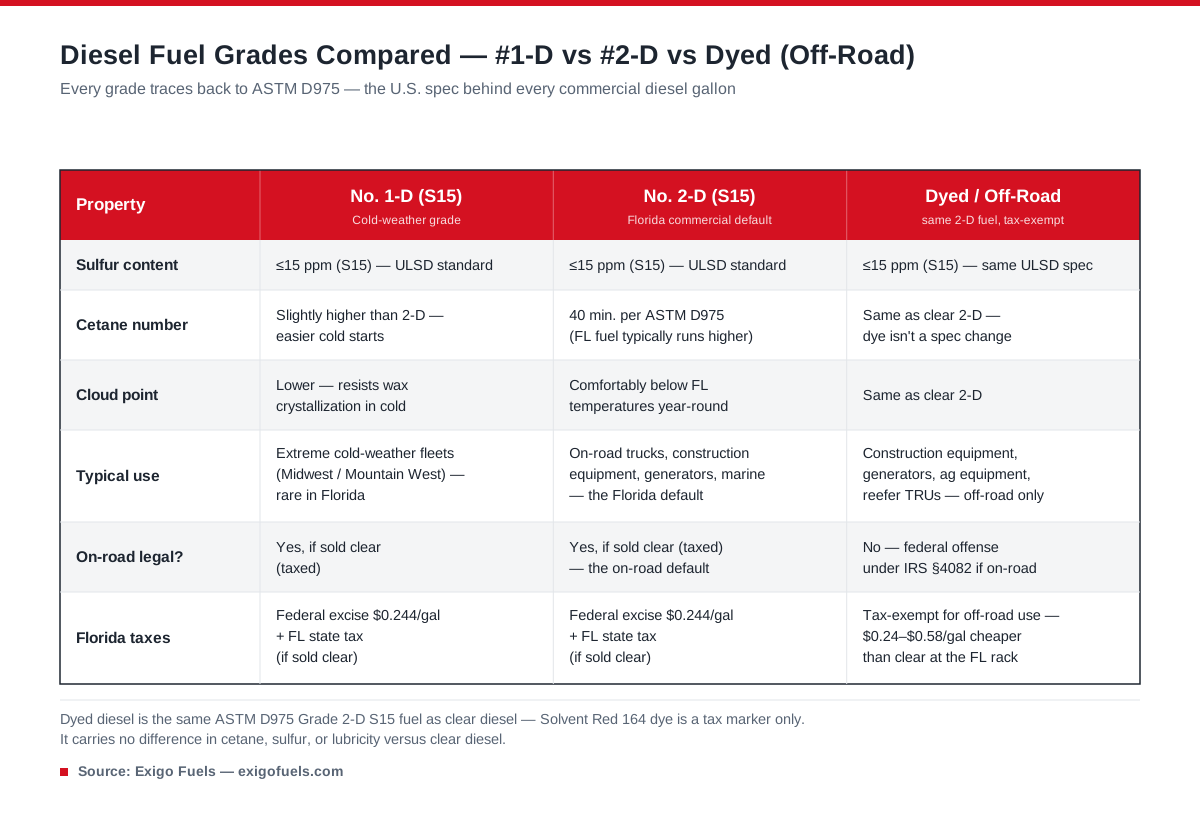
Use this chart on your site
Free to use with attribution.
<a href="https://www.exigofuels.com/blog/diesel-fuel-grades-explained/"><img src="https://www.exigofuels.com/charts/diesel-fuel-grades-comparison.svg" alt="Diesel fuel grades comparison chart by Exigo Fuels"></a>
<p>Chart by <a href="https://www.exigofuels.com/">Exigo Fuels</a></p>
ULSD and sulfur content — the grade behind every grade
Since 2010, essentially every gallon of diesel sold commercially in Florida — 1-D, 2-D, dyed, or clear — is Ultra-Low Sulfur Diesel (ULSD): 15 ppm sulfur maximum. That single number is what allows modern Tier 4 and EPA2010+ engines to run their emissions aftertreatment (Diesel Oxidation Catalyst, Diesel Particulate Filter, and Selective Catalytic Reduction) without being poisoned or clogged by sulfate ash. We go deep on why this matters mechanically — and what happens when a supplier delivers off-spec fuel — in our ULSD vs regular diesel guide.
The practical takeaway for grade shopping: if a Florida supplier quotes you "diesel" without qualification, assume ULSD Grade 2-D S15, clear, unless you specifically requested off-road dyed. Anything less than 15 ppm sulfur is effectively unavailable at legitimate Florida terminals for on-road or Tier 4 non-road use, so sulfur content isn't something you need to negotiate — it's the floor for legal delivery.
Winterized diesel blends — and why Florida fleets almost never need them
Up north, "winterized" or "winter blend" diesel is a seasonal necessity: suppliers blend in 1-D or cold-flow-improver additives to depress the cloud point and pour point of standard 2-D low enough to survive hard freezes without gelling in fuel filters and lines. Cold weather gelling is one of the most common seasonal fleet failures nationally, and an entire seasonal supply-chain adjustment exists to prevent it.
The tradeoff is worth stating plainly, because it is the whole reason the two grades exist. #2-D carries roughly 5–8% higher energy per gallon than #1-D, so it delivers better fuel economy and more torque from the same tank. #1-D flows at extremely cold temperatures where #2-D would wax up, but you pay for that in energy efficiency. In colder climates fleets accept the loss for months at a time; in Florida there is nothing to buy your way out of, so #2-D stays in the tank year-round and the vehicles and equipment on it keep the higher energy density all twelve months.
In Southeast Florida, this is largely a non-issue. Standard #2-D S15 as formulated and delivered at Florida terminals has a cloud point comfortably below anything Miami-Dade, Broward, or Palm Beach County ever experiences, even during an occasional January cold snap. You don't need winterized blends, anti-gel additives, or a seasonal fuel-switch conversation with your supplier here the way a fleet manager in Ohio or Minnesota does every October. It's one of the quieter operational advantages of running a fleet in South Florida rather than a genuine cold-climate market — one less seasonal task on the maintenance calendar, and one less way for a cold morning to leave a truck stranded on the shoulder.
The one caveat: fleets or vessels that travel north out of state for any stretch of winter should plan around whatever regional blend they'll encounter en route, since Florida-formulated fuel already in the tank won't automatically match a colder climate's winter spec.
Biodiesel blends — B5, B20, and what ASTM D975 actually allows
Biodiesel (typically made from soybean oil, used cooking oil, or animal fat, and meeting its own ASTM D6751 spec) is commonly blended into petroleum diesel at varying percentages, and the labeling matters:
- B5 (up to 5% biodiesel) — ASTM D975 permits blends up to 5% biodiesel to still be sold and labeled simply as "diesel fuel." This is common in commercial supply and generally requires no special handling or engine consideration for modern diesel equipment.
- B6–B20 (6% to 20% biodiesel) — falls under a separate specification, ASTM D7467, which sets additional stability and cold-flow requirements specific to higher-percentage blends. Many diesel OEMs support B20 under warranty; some cap coverage lower, so it's worth checking your specific engine manufacturer's position before committing a fleet to B20 long-term.
Biodiesel blends above B5 bring a couple of practical considerations worth knowing regardless of climate: biodiesel has a mild solvent effect that can dislodge accumulated deposits in older fuel systems, so fleets switching to a higher blend for the first time sometimes see faster-than-normal filter changes in the first few tank cycles as the system cleans itself out — expected, not a fuel-quality defect. Biodiesel also has a somewhat higher cloud point than straight petroleum 2-D, which matters more in cold climates than in Florida. Higher blends are a different specification layered on top of the base diesel grade, not a replacement for it. Exigo Fuels does not sell B20 or other biodiesel blends as a product; our diesel is ASTM D975 Grade 2-D S15 ULSD.
Benefits of diesel #2 for Florida operations
Put the grades side by side and the case for #2-D in this market is short. Compared to diesel #1 it holds higher levels of energy per gallon and costs less at the rack. Compared to gasoline it produces more work per gallon and stores far longer without degrading, which is what makes it the default for standby generators. And the one type of diesel decision that dominates the rest of the country — which winter blend to run — simply does not apply here. For a fleet in Miami-Dade, Broward, or Palm Beach, the grade question collapses into two: clear or dyed, and whether the equipment needs Tier 4-compatible ULSD, which in practice everything delivered here already is.
What Florida fleets actually buy, by industry
Strip away the spec-sheet detail and here's what commercial buyers in Miami-Dade, Broward, and Palm Beach counties are actually ordering, industry by industry:
| Industry | Typical fuel | Grade / classification |
|---|---|---|
| Construction (equipment on site) | Off-road diesel for excavators, loaders, generators, compactors | 2-D S15, dyed |
| Construction (haul trucks, service vehicles) | On-road diesel for anything that drives on public roads | 2-D S15, clear |
| Marine (inboard diesel engines) | Standard marine diesel; tax treatment varies by vessel type and use — see our marine fuel guide | 2-D S15 |
| Backup / standby generators | Off-road diesel for stationary generators (hospitals, data centers, condos, industrial) | 2-D S15, dyed |
| Refrigerated fleets (reefer TRUs) | Off-road diesel for the TRU's own separate tank (non-propulsion engine); the tractor still runs on clear diesel | 2-D S15, dyed (TRU) / clear (tractor) |
| Agriculture (tractors, irrigation, dryers) | Off-road diesel for non-road farm equipment | 2-D S15, dyed |
| General on-road commercial fleet | Standard on-road diesel for trucks, vans, buses | 2-D S15, clear |
Two patterns show up repeatedly. First, almost every Florida commercial account is buying Grade 2-D S15 — the 1-D and 4-D conversation is mostly academic here. Second, the decision that actually changes the invoice is dyed versus clear, which tracks whether the equipment ever touches a public road, not what industry the customer is in. A single construction company routinely buys both: dyed for the excavators, clear for the dump trucks — sometimes on the same site, same day, same delivery.
How to order the right grade — what to tell your supplier
Ordering the correct diesel grade in Florida is simpler than the spec sheet makes it look. A supplier needs four pieces of information to get it right:
- What the fuel powers. A specific piece of equipment, vehicle class, or generator — this determines whether Grade 2-D S15 (nearly always) or something else applies.
- Whether it ever operates on public roads. This is the dyed-vs-clear question, and it's the one with real legal consequences if answered wrong. Be specific — "the truck never leaves the site" is different from "the truck occasionally runs a supply errand."
- Delivery volume and frequency. Bulk tank fill, scheduled recurring delivery, or one-time top-up — this affects pricing tier and dispatch scheduling more than the grade itself.
- Any compliance documentation requirements. Healthcare, government, FDOT, and LEED-certified accounts typically need batch certificates, Bills of Lading, and delivery tickets bundled per delivery — flag this at account setup, not delivery day.
Exigo Fuels delivers ASTM D975 Grade 2-D S15 ULSD — both clear on-road and dyed off-road — across Miami-Dade, Broward, and Palm Beach counties, with tax-exempt off-road accounts documented once at setup and every delivery covered under that certification afterward. See our ULSD delivery and off-road diesel delivery service pages for pricing and coverage, or request a quote and tell us what you're fueling — we'll confirm the right grade and classification before the first delivery.
One mistake worth flagging explicitly: don't let a mixed-equipment site default to "just send diesel" without specifying dyed or clear for each tank. It's the single most common way a compliant contractor ends up with an accidental IRS §4082 exposure — a driver tops off the wrong tank, or a new hire doesn't know which color hose goes where. A supplier who asks the classification question on every order, every time, is doing you a favor even when it feels repetitive.
Frequently asked questions
Answers to the questions we hear most often from Florida fleet managers, contractors, and facility operators about diesel fuel grades. These answers also feed the FAQPage schema on this page. For a delivered quote on the correct grade for your equipment, call (305) 900-6725 or request a quote online.
Frequently asked questions
What are the grades of diesel fuel?
ASTM D975 defines several grades of diesel fuel oil, though only a few show up in commercial Florida supply. No. 1-D S15 is a lighter, kerosene-like distillate with excellent cold-flow properties. No. 2-D S15 is the standard, higher-energy diesel that powers the vast majority of on-road trucks, construction equipment, and generators — this is what "diesel" means by default. No. 4-D is a heavier grade for low-speed and medium-speed stationary and marine engines, rarely encountered outside industrial-scale equipment. Layered on top of the grade: dyed (off-road, tax-exempt) versus clear (on-road, taxed), and an optional biodiesel blend percentage (B5, B20).
What is the difference between #1 and #2 diesel?
No. 2-D carries more energy per gallon and is the standard grade for on-road trucks, construction equipment, and generators. No. 1-D is a lighter distillate with a lower cloud point — meaning it resists wax crystallization and gelling at colder temperatures — at the cost of lower fuel economy. No. 1-D is typically blended into 2-D (or an equivalent cold-flow additive is used) during winter months in genuinely cold climates. In South Florida, standard No. 2-D S15 covers essentially every application year-round.
Is off-road diesel a different grade than on-road diesel?
No. Off-road (dyed) and on-road (clear) diesel are the same ASTM D975 grade — almost always Grade 2-D S15 — differentiated only by a red dye added at the terminal to mark fuel sold tax-exempt for qualifying off-road use. The engine can't tell the difference; the distinction is legal and fiscal, not mechanical. See our full dyed diesel tax guide for the details.
What diesel grade do trucks use in Florida?
Virtually all on-road trucks in Florida run Grade 2-D S15 clear diesel — standard Ultra-Low Sulfur Diesel with federal and state highway taxes included. Off-road equipment attached to those same fleets (generators, construction machinery) typically runs the same 2-D S15 grade in its dyed, tax-exempt form. The grade doesn't change between the two; only the tax classification does.
Is dyed diesel lower quality than regular diesel?
No. Dyed diesel is identical in every performance-relevant property to clear diesel — same ASTM D975 Grade 2-D S15 specification, same sulfur limit, same cetane, same lubricity. The red dye is a tax-enforcement marker with zero effect on combustion, aftertreatment, or engine performance. The only "damage" from using dyed diesel improperly is legal, not mechanical.
Do I need winterized diesel in Florida?
No, essentially never. Winterized blends exist to depress the cloud point of diesel so it doesn't gel in cold-climate winters. Standard Grade 2-D S15 as delivered in Miami-Dade, Broward, and Palm Beach counties already has a cloud point comfortably below anything South Florida experiences, so seasonal cold-flow blending isn't part of the normal Florida commercial supply cycle.
Can biodiesel blends be used in any diesel engine?
Blends up to B5 (5% biodiesel) are covered under standard ASTM D975 and are broadly compatible with modern diesel equipment. Blends from B6 to B20 fall under a separate specification (ASTM D7467) with added stability requirements, and most diesel OEMs support B20 under warranty — though it's worth confirming your specific engine manufacturer's position, since a few cap coverage lower. Exigo Fuels does not sell B20 or other biodiesel blends as a product.
How do I know which diesel grade my equipment needs?
For nearly all Florida commercial equipment — trucks, construction machinery, generators, marine engines — the answer is Grade 2-D S15 ULSD. The decision that actually changes your order is whether the equipment operates on public roads (clear, taxed) or exclusively off-road (dyed, tax-exempt). Tell your supplier what the fuel powers and where it operates, and a compliant Florida supplier will confirm the correct grade and classification before delivery.
Ready to see your fleet's savings?
Use our free calculator for an instant estimate, or call a fleet specialist for a custom quote based on your exact volume and ZIP.